Gary Farrar
Vice President, Sales Enablement
For more than a decade, Gary has advanced through multiple roles at Agile Mind, now managing the Educator Outreach Team and collaborating closely with Sales and Marketing leadership.
As a sales development leader, Gary drives strategies that expand market presence and accelerate revenue growth. He is recognized for building high‑performing teams and aligning solutions to the evolving needs of educators and students.
As a proud University of North Texas alum, Gary is passionate about life and sales development and is committed to helping others succeed.
Carrie Tracy
Regional Director of Professional Services
Carrie Tracy is the Regional Director of Professional Services, overseeing the West Coast, Rocky Mountains, and the Great Plains regions. Her extensive background in education includes serving as a school principal, preceded by a variety of roles focused on secondary mathematics, including junior high math teacher, district math specialist, and master teacher through Texas Instruments. Carrie also gained valuable experience supporting teachers new to the instructional coach role through her work with the Institute of Public School Initiative’s Algebra Readiness Grant. Carrie holds a Master’s in Educational Administration and a Bachelor’s of Science in Education with a minor in Mathematics from Texas A&M University. In her free time, she enjoys reading, hiking, & traveling to see new places.
Lisa Williams
Regional Vice President
Lisa is a Regional Vice President at Agile Mind, where she helps districts transform the math experience for both students and teachers. A former high school educator, Lisa has 25+ years of experience in the K-12 educational sales market. She most enjoys working with administrators and teachers across the country in their joyful quest to provide every student the opportunity to succeed in school and after graduation.
Outside of this important professional work, Lisa enjoys sewing and trying new recipes. Besides her family, she loves her cats, who make frequent appearances in Zoom meetings.
Abby Dawson
Sales Operations Manager
Abby is Agile Mind’s Sales Operations leader and is one of the founding team members, having been with the company since its formation in 2002. Abby has extensive experience in CRM management, sales, partner services and data analytics. She is passionately committed to Agile Mind’s equity mission to help teachers serve all students’ needs and achievement. Outside of the business day, Abby enjoys traveling and genealogy research.
You can see how this popup was set up in our step-by-step guide: https://wppopupmaker.com/guides/auto-opening-announcement-popups/

Andrew Paulsen, Ed.D.
Regional Director of Professional Services
Dr. Andrew Paulsen currently serves as the Regional Director of Professional Services for the Midwest. Paulsen was formerly a High School Math Teacher and Instruction Coach in the Newark Public Schools and spent time abroad as a Fulbright Scholar researching eastern pedagogy and policy in Kaohsiung, Taiwan. Dr. Paulsen is passionate about improving college access for traditionally underrepresented students and increasing educational attainment for incarcerated adults.
Originally from Levittown, New York, Andrew received his B.A. from Marist College, earned his Master’s in educational policy from Seton Hall University, and holds an Ed.M. in public school leadership from Columbia University. Andrew earned his doctorate in education from Vanderbilt University in 2021, and currently lives in Detroit, Michigan. In his free time, he enjoys cooking, scuba diving, and traveling around the world.
Charlotte Dowd
Vice President of Marketing
Charlotte serves as Agile Mind’s Vice President of Marketing. In this role, she oversees the company’s strategic marketing communications engaging with internal and external partners. With over 20 years in online educational technology publishing and implementation for K12 and higher education entities, Charlotte is committed to developing meaningful engagements, while maintaining the utmost integrity and audience respect in presenting Agile Mind’s mission and brand.
In her spare time, Charlotte enjoys documentary films, summer and winter outdoor activities in New England where she lives, and hanging out with her husband and their 15-year old daughter.
Massie McAdoo
Regional Vice President of Professional Services
Director of Professional Services Education Consultants
Dr. Massie McAdoo is a passionate champion for the continuous improvement of teacher and learner practices in secondary mathematics classrooms. As a Regional Director of Professional Services, she designs and leads professional learning experiences that expand the capacity of leaders and teachers to ensure that all students have access to high-quality instruction and innovative resources. Massie’s expertise is grounded in real-world experience. Before joining Agile Mind, she served as an Instructor of Mathematics at Tuskegee University and Kennesaw State Universities, a middle grades and high school mathematics teacher, Mathematics Department Chair, and a Teacher on Special Assignment for the Georgia Department of Education.
Massie holds a Doctor of Philosophy degree in Curriculum and Instruction and a Master of Science degree in Mathematics from Auburn University, a Bachelor of Science degree in Mathematics from Tuskegee University and a Bachelor of Science degree in Education (Secondary Education) from Kennesaw State University. Her scholarly presentations focus on strategies to increase the number of underrepresented populations in the STEM pipeline.
Abby Neumeyer
Regional VP of Professional Services
Director of Design & Initiatives
Abby Neumeyer is a Regional Director of Professional Services at Agile Mind. In this role, she serves teachers and leaders who aspire to improve mathematics outcomes for all secondary learners through enactment of research-based practices, programs, and systems. Prior to Agile Mind, Abby was a high school math and science teacher and coach in the South Central Texas area. Abby holds a Master’s Degree in Educational Administration from Lamar University.
Laurie Mayhan
Sales Operations Manager
Laurie is Agile Mind’s Sales Operations leader and is one of the founding team members, having been with the company since its formation in 2002. Laurie has extensive experience in CRM management, sales, partner services and data analytics. She is passionately committed to Agile Mind’s equity mission to help teachers serve all students’ needs and achievement. Outside of the business day, Laurie enjoys traveling and genealogy research.
Holly Wale
Director of Partner Services
Holly Wale helps businesses improve Partner retention by optimizing digital and material fulfillment and providing exemplary implementation and support services.
As National Director of Partner Services, she oversees the Partner Services and Roster Teams. She works closely with all Agile Mind teams to ensure the best possible Partner experience for all enacting Partners.
In her free time, Holly enjoys cooking, hiking, and reading.
Brett Felten
Regional VP of Educational Partnerships
In his daily work, Brett collaborates with current and prospective district partners to ensure their secondary teachers and students are best prepared for the world of work. As a Regional Vice President of Educational Partnerships at Agile Mind, he oversees district relationships in the eastern half of the country, as well as other key organizational partnerships. For Brett, working with district leaders to greatly increase the number and diversity of students finding success in mathematics is by far, the most rewarding part of the role. Outside of the office, Brett enjoys spending time with family and friends, traveling, and playing in wiffle ball tournaments.
Kristin Armistead
National Vice President
Kristin is the National Vice President of Sales for Agile Mind, where she’s worked for over 12 years. She brings 15 years of educational sales experience in the K-12 market and is passionate about academic and instructional equity. In her role at Agile Mind, she partners closely with school districts to identify and prioritize areas of need and provides high-quality solutions and strategic planning. She is particularly inspired by the company’s work around intensification and College and Career Readiness. Kristin is a lifelong learner and is committed to serving both students and educators across the nation.
Outside of the business day, she enjoys traveling, spending time with her family and friends, and her volunteer work with the school board and community.
Am Norgren
Regional Director of Professional Services
Am Norgren began his career as a secondary mathematics teacher in Prince George’s County, Maryland, establishing himself as a respected educator and professional development facilitator. Currently working as a Regional Director of Professional Services for Agile Mind, Am supports school systems with their mathematics curriculum implementations. Am Norgren holds a Master of Arts in Teaching in Secondary Mathematics Education from American University and a Bachelor of Science in Mathematics from Arizona State University. Outside of the office, Am enjoys camping, sailing, and spending time with his nephews.
Michele De La Garza
Regional Director of Professional Services
Michele is a native of San Antonio, Texas, and began her teaching career in Edgewood ISD where her passion for learning and community flourished. As a first-generation college graduate, she earned a Bachelor’s of Science in Mathematics, Masters of Education in Curriculum and Instruction, and Masters of Educational Leadership from the University of Texas at San Antonio. Michele brings 13 years of secondary classroom experience and expertise as a middle and high school mathematics teacher. She also brings campus and district leadership experience as a high school Instructional Dean of Mathematics, middle school Academic Dean and Assistant Principal in Northeast ISD and K-12 Director of Mathematics in San Antonio ISD. Michele is driven by the belief that the power to positively impact students lies within us and our ability to create a culture of professional learning that improves teacher efficacy and student learning.
Alisa Rafter
Program Development Manager
Alisa is the program development lead for Agile Mind’s secondary mathematics course programs. In this role, she oversees the creation of curriculum and resources to support transformative teaching and learning, including programs such as Intensified Algebra and Intensified Mathematics I that leverage psychology and learning science interventions to support struggling students. With more than 20 years in educational publishing, Alisa is committed to developing resources that leverage best practices in ways that are practical, scalable, and highly effective for a range of learners. Alisa is raising a family in San Francisco, where she enjoys volunteering with native habitat restoration projects around the bay.
Peter Walsh
Director of Program Development
Peter is the Director of Program Development for Agile Mind’s programs. He manages the development of industry-leading curriculum and tools that support students as they are approaching and transitioning to the new academic and social rigors of high school. With more than 15 years in education and 6 years in the classroom, Peter is passionate about helping teachers transform the lives of their students. Outside of Agile Mind, Peter enjoys exploring the outdoors and making up games with his wife and two young children.
Deborah Zimmerman
Vice President of Production
Debbie directs a team of project managers, instructional designers, artists, animators, and front-end programmers to build Agile Mind’s instructional materials. She works closely with our program development team and our partners at the Charles A. Dana Center to ensure that Agile Mind materials make outstanding use of the online, interactive medium to bring math and science concepts to life for students in the most engaging ways possible. Watching students have “aha” moments with Agile Mind is the most rewarding part of her job.
Outside of the office, Debbie enjoys traveling and water sports with her husband and two daughters.
Gregg McFarland
President of Agile Intiatives
Gregg has supported schools and districts to develop strategic plans for educational improvement with Agile Mind for nearly 20 years. Before joining the Agile Mind founding team as Chief Operating Officer, Gregg began his career as a CPA in the audit and consulting practice of KPMG. He was a founding executive of Jostens Learning, an educational software publisher and services provider for pre-K to adult learners. At Jostens he held a number of executive positions including chief financial and administrative officer, vice president and general manager of package software, and senior vice president responsible for national sales, marketing, government relations, and customer service. In the mid-90s, Gregg founded Whole Village Technology, a pioneering educational application service provider. In partnership with the state of Florida, Whole Village created ActionProfiler, a tool for enhancing parental involvement in student learning.
David Savage
VP and National Director of Professional Services
David Savage helps schools and districts operationalize strategic plans to support student achievement through exemplary, sustainable teaching practices. As Vice President and National Director of Professional Services, David leads our team of exceptional educators in their work with district leaders, school principals and teachers to transform teaching and learning outcomes in every classroom through implementation planning and professional learning support. He also works with our university, research and philanthropic partners to learn from the work of Agile Mind teachers and leaders to strengthen our programs and services and to contribute to the field of K-12 education broadly. David lives just outside of Washington DC, in Maryland, where he enjoys kayaking, gardening and hiking.

Clarence (Andy) Felong
VP of Engineering
Andy brings more than 25 years of experience in software development, IT management, quality assurance, and operations to this leadership role.
Before joining Agile Mind, Andy served as CTO and VP of advanced technology at Walmart.com, where he oversaw end-to-end e-commerce architecture, ensuring a scalable, available, and secure platform. Prior to that, Andy was CTO and vice president of engineering at Internet start-up More.com, where he was responsible for integrating business systems, including supply chain management, customer relationship management, and data warehouses with the company’s web portal. Andy also served as vice president of the Internet Applications Division at Oracle, with responsibility for technology management of e-commerce, collaboration, web portals and document management. He also spent eight years at Apple Computer in a variety of capacities ranging from managing software development for the original PowerBooks to senior director of communications and collaboration technologies, which included responsibility for Apple’s collaborative learning products. Andy began his career writing real-time imaging software for Voyager Spacecraft at the Jet Propulsion Laboratory. He is an active contributor to the Open Source community and maintains an online resource of wearable computer technologies.
John Moore
VP of Sales and Educational Partnerships
John Moore has over 25 years of experience in U.S. and international market development and sales strategy, customer relationship management, and organizational development. John has consulted extensively in the education and educational technology sectors, supporting new market initiatives, innovative product strategies and the development of sales and service organizations. John brings deep knowledge and experience in direct sales initiatives in the K-12 education sector, including sales channel development, consultative sales, and customer service models and regional partnership arrangements. John received his undergraduate degree from Georgetown University and a master’s degree from the University of Michigan. He has presented on education sector trends at numerous conferences and events around the world.
Linda Chaput
Founder & CEO
Linda Chaput, founder and CEO of Agile Mind, Inc., leads our efforts to transform the teaching and learning of mathematics and science in our nation’s middle and high schools. Under Linda’s leadership, Agile Mind is realizing its commitment to help educators teach smarter and to equip students to take more responsibility for their learning. Before founding Agile Mind, Linda founded and led Cogito, which developed supplemental digital resources for critical competency subjects in higher education. Earlier, for almost a decade, Linda led the education and reference publishing companies of Scientific American. Linda has been named one of the 10 Most Powerful Women Entrepreneurs, an award created to honor “the most innovative, ground-breaking, game-changing female entrepreneurs in the U.S.” by Fortune Magazine and American Express OPEN. She received a B. S. in journalism from the William Allen White School of Journalism at the University of Kansas.

Interested in a Demo?
New Features for Our Educators with Agile Mind Update
Educator Support, News/UpdatesThe latest version of the Agile Mind Update that releases in early December 2022 introduces new features that have been requested by our educators. Here’s how we’ve been listening to you!
New easy-to-share links to assignments, quizzes, and tests
A shareable link is automatically copied to an educator’s clipboard when a new assignment, quiz, or test is created. Educators can also get a link to share with students from the action menus on their Calendar. This link can be shared via email, added to Google Classroom, or pasted into a homework management app, for example.
More flexible quiz scheduling for real-life classroom scenarios
We now offer even more flexible quiz scheduling to support how you teach in your classroom. From absent students to quiz corrections to student accommodations, we’ve got you covered with our new quiz extension feature. Quiz extensions let you give the same quiz at different times to the students in a class. Support students with additional time? Have a student who needs to take the quiz before or after the rest of the class? Prefer to schedule a makeup quiz or give your students a chance to correct their answers? No problem!
Ready to learn more?
To learn more about these and other new features, click the Help button in the top right corner of your Agile Mind window and choose the “New in Agile Mind” option. We’ll get you started with our how-to video. You can also reach out online if you have questions.
Partnership Spotlight: Lynnwood High School Aims to Tackle Critical Math Skills with Intensified Algebra I Course
Math Achievement, Partner SuccessMath Leaders Aim to Tackle Critical Math Skills with Intensified Algebra I Course
Lynnwood High School’s story of success begins in their approach to 9th grade Algebra I. Agile Mind’s Intensified Algebra I course helped students not only learn necessary advanced math skills, but also learn to push themselves through points of struggle, while bolstering their confidence in their ability to learn critical math skills. Hear from students at Lynnwood High School about the outcomes they’ve experienced through our intensified math course.
Partnership Spotlight: Culberson County – Allamoore ISD, TX
Math AchievementEnglish Language Learners Gain Extra Support with Agile Assessment Update
Assessment, Math AchievementEducator Spotlight: Calvin Lopez from Brooklyn, NY
Educator SupportEngaging English Language Learners in Mainstream Classrooms
Math AchievementTransforming Opportunities Through High School Mathematics
Math AchievementEducator Perspectives: Academic Youth Development Supports Algebra for All in New York City
Math Achievement, Social Emotional Academic DevelopmentSocial, Emotional, and Academic Development (SEAD) Essential for Success in a COVID World
Math Achievement, Social Emotional Academic DevelopmentFor educators and education systems, it is critical to support students’ capability, purpose, and sense of belonging in school—now more than ever. Communities, schools, and families are working through extraordinary challenges to create opportunities to learn—for both educators and students. Despite setbacks and rapidly evolving circumstances, they continue to create meaningful connections and learning experiences.
Students learn best when they are ready to learn—when they are relatively free of stress and anxiety, when they feel connected to their teacher, when they are part of a community and invested in its work, and when they know and understand what is expected of them. Creating those conditions presents entirely new challenges this year, but educators across the nation will attest that it can be done. And the work to do so has revealed that—while we confront new conditions, demands, and tools—best practices for teaching and learning remain.
Here we highlight key strategies shared by educators and experts that support students’ social, emotional, and academic development in 2020-2021:
The Aspen Institute, 2019
Integrate students’ social and emotional learning with academic work
SEAD describes the integration of social and emotional learning competencies and skills with academic learning. SEL skills can be explicitly taught and practiced. Integrating this work with academic learning helps students internalize and generalize new competencies to learning experiences across their school day and has significant positive impacts on the culture and climate of learning.
Create a strong culture of learning from the start
School is a safe, stimulating place for so many students. Amid disruptions and distance learning efforts, many districts have prioritized work to intentionally build safe learning spaces at the start of the year. Even remotely, teachers are applying strategies that help build a culture where each student has a voice, where everyone is valued, and where mistakes are expected, respected, and inspected.
A strong learning environment welcomes students into the community, promotes effective mindsets for learning, and gives students tools to manage their learning. When students feel they belong, believe in their ability to learn, and are equipped with effective problem-solving strategies, they work harder, persist longer, and achieve at higher levels.
Focus on equity
When equity is prioritized, we start with the expectation that everybody brings something to the table, everyone has value, and everyone belongs. Many educators are applying an equity lens to their teaching. They are learning how culturally responsive practices support high-quality instruction, and how strategies they may already use—such as posing purposeful questions and managing students’ productive struggle—enhance access to learning for all.
This year, of particular concern for the start of school are challenges with equitable access to technology. We see educators, families, and communities making exceptional efforts to serve students, yet many still face barriers. For remote learning, many teachers are leveraging technology to facilitate effective synchronous (live) sessions. However, students with limited access to technology can benefit from meaningful asynchronous (not time-specific) learning experiences to be completed independently, with windows of time available for individual or small-group support.
Develop and apply norms and routines
Though the work to develop and consistently use norms and routines might not seem transformative, it is essential for establishing and deepening positive, equitable learning environments. Routines and norms promote meaningful and respectful discourse that is organized around students’ shared work, and help teachers build safe spaces for learning.
Teachers have always valued norms, but this year they are particularly important. Most students have been away from school for an extended period, and in the beginning of the year, teachers and students may not be learning in the same place at the same time. Many educators are leveraging two types of norms: norms for establishing and managing a supportive community of learners and norms for using technology in remote or hybrid learning models. Establishing both sets of norms increases the likelihood that all students will engage and fully participate in their learning experiences.
Engage educators in the practices expected of students
The most effective professional development—particularly this year—both engages educators in learning that develops their capacity and also models effective practices they can bring to their roles. Teachers can more easily and rapidly apply new practices when they have experienced them in their own learning—whether for prompting and managing collaboration and discourse, developing and applying effective norms and routines, using roles in collaboration, or introducing, managing, and debriefing tasks and group work.
This year, Agile Mind’s teachers have benefitted from professional learning experiences that model best practices for remote learning, including how to build a welcoming, positive culture of learning when you’re not physically together, how to organize and manage students’ work individually and in groups, and how to leverage various technology and collaboration tools.
Finally, like students, educators can develop their learning mindsets. Teachers’ beliefs in students’ capacity are critical and can deeply impact students’ beliefs about themselves and their ability to learn. When so much is uncertain, we must ensure that all students know that the adults they encounter believe in their potential.
For information about how SEAD work is done programmatically, visit our Academic Youth Development (AYD) page.
For related information, visit:
Learning on Smartphones: More Access for More Students
Core Math, Math AchievementSupported by the Bill & Melinda Gates Foundation
Background
Closing the Achievement Gap in Mathematics
Black, Latinx, and low-income students disproportionately underachieve their better-advantaged peers in mathematics. Removing this barrier to upward mobility is our mission.
What have we found in our efforts to close this achievement gap? Students using Agile Mind’s blended mathematics programs—that is, a combination of online and pencil-and-paper experiences for whole group, small group, and individual learning—are achieving at or above the levels of their more advantaged peers and are succeeding in Algebra at historic rates. How? We work intensively with our authors at the Charles A. Dana Center at The University of Texas at Austin, and with other experts in instruction—both for adults and for students—and in assessment to challenge students with engaging but rigorous curriculum aligned to their state standards, and we support their teachers with tools and training that extend their reach beyond the classroom.
Problems Remain
Out-of-classroom work in mathematics exposes other challenges, however: not all students have equitable access to technology outside of school. Teachers know this and hesitate to assign online problems outside of class, even though practice with worthy tasks is a powerful tool for success. Instead, many teachers assign printed worksheets they have known for years—most created before the next-generation standards. The result?
The Opportunity
What if we could broaden access of online assignments to include those without computers or Internet access at home? Would it benefit those students directly, and would it encourage teachers to assign online problems, thereby benefitting all students?
To find out, we reengineered our next-generation interactive problems for middle school, Algebra, and Integrated Math 1, with support from the Bill & Melinda Gates Foundation, to make them accessible by smartphone.
To make the online portion of Agile Mind’s mathematics services available to more students outside of the classroom, we made the following improvements:
We believe that, when teachers worry less about equitable access, they will not hesitate to assign online problems. Students will benefit from this change in teacher practice, and, if they find the problems more engaging, will spend more time on assignments. In the end, the more time students spend solving math and science problems that are worthy of their time, the more successful they will be. With only months, not years, of data, we are well down the road to proving out this logic chain.
Results
More Assignments Made and Completed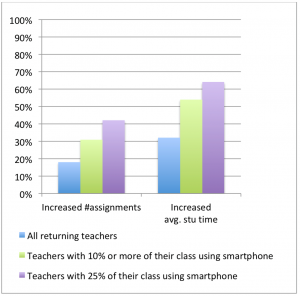
By enabling smartphone capabilities, Agile Mind helped educators in more than 200 districts remove barriers to high-quality homework experiences for 250,000 students.
We saw dramatically higher percentage of teachers are making online assignments for their students—a 60% increase over the prior year. The increases were the greatest in schools where the greatest percentage of students use smartphones for homework.
We also saw the percentage of assignments completed by students has also increased significantly. In a significant number of schools, 95% of students are completing assignments, up from as low as 30% in some schools.
The data clearly suggest that increasing equitable access to Agile Mind through smartphone capabilities correlates with a change in teacher and student practice in use of the assignment features, and therefore to increased access for students to meaningful learning opportunities.
Analysis
To better understand these data, we conducted interviews and surveys with representative teachers, teacher leaders, and administrators. Teachers report the following benefits of smartphone access to Agile Mind assignments:
Building on Success
Distance Learning During the Pandemic
These data suggest smartphone work provides more students access to high-quality math learning resources and problem-solving tasks. At the end of this school year, which was interrupted by the COVID-19 pandemic, these tools became critical in supporting student access to distance learning opportunities.
Expansion
To continue this work, we aim to make even more curriculum content available to students via smartphone and to allow students to access that content directly, whether or not a teacher assigns it. We are also working to improve aspects of the user interface design for more of our courses.
Professional Development
We are eager to support teachers in how best to use these powerful tools. We aim to build multi-pronged communications and professional development outreach to support teachers in how to use new capabilities, such as smartphone access, to work them into their instructional practice, and to introduce them to their students.